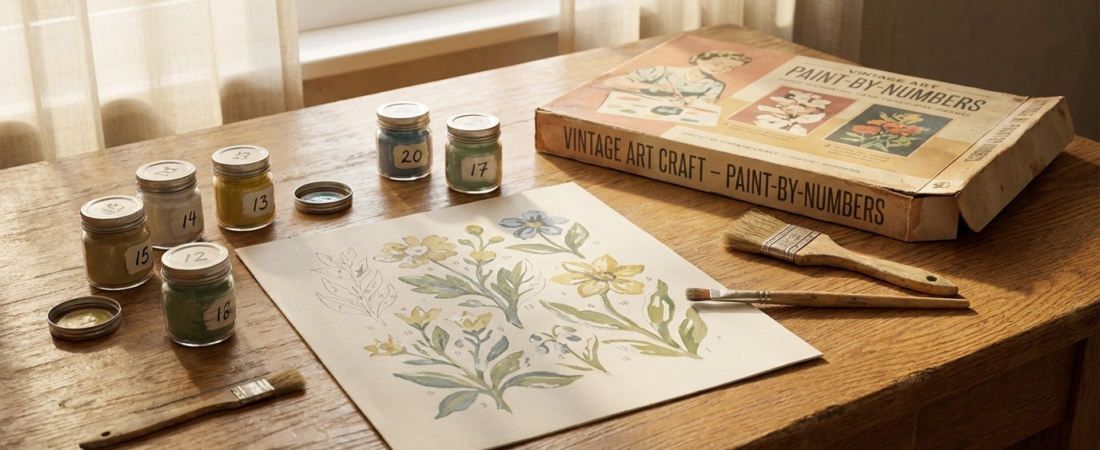
Paint by numbers doesn’t require any artistic skill — the format was built specifically to remove that requirement. The canvas already has the outlines. The paint already comes matched to a number. The only decision left standing between you and a finished piece is whether to stay inside a shape. If you can match the paint labeled 6 to the space marked 6, you can finish a canvas. What this hobby rewards is patience with small details, not hidden talent.
Why This Actually Works
For someone like me who isn’t particularly artistic, the thought of taking up painting has always been intimidating. And even though I did paint by numbers as a kid, it never occurred to me that it might be a fun adult hobby. When I embarked on my screen-free evenings journey, I thought I’d give paint by numbers a go. I was immediately shocked at how relaxing and satisfying it was. Ironically, the hard part wasn’t handling the paint and the brush. It was leaving my phone in another room long enough to properly finish each section.
An article in Smithsonian Magazine traces paint by numbers to 1951. Palmer Paint Company owner Max Klein and package designer Dan Robbins launched Craft Master kits built for total beginners. The box tops famously promised “every man a Rembrandt.” The numbers do the compositional work a trained eye would otherwise have to supply.
There’s a second mechanism at work that makes paint by numbers effective for relaxation. It has less to do with art than with decision fatigue. A 2005 study published in Art Therapy, the journal of the American Art Therapy Association, found that coloring a structured, pre-drawn pattern lowered participants’ anxiety more reliably than free-form drawing on a blank page. The researchers attributed the benefit to removing open-ended creative choices, not to the act of coloring itself. A paint-by-number canvas handles almost all those choices: no blank page, no color mixing, no composition to invent.
At a Glance: Myth vs. Reality
- Myth: You need to know how to draw. Reality: The outlines are already printed on the canvas.
- Myth: You need to understand color theory. Reality: Every color comes pre-mixed and numbered to match.
- Myth: It’ll look like a kids’ craft project. Reality: Current kits use textured canvas, muted palettes, and gallery-style scenes.
- Myth: Finishing one takes an artist’s patience. Reality: A first canvas usually finishes in a handful of evenings, not weeks.
- Myth: A finished canvas isn’t real art worth hanging. Reality: Framed paint-by-number pieces are a recurring home-decor category, not a novelty.
Do You Need Any Art Skill to Start?
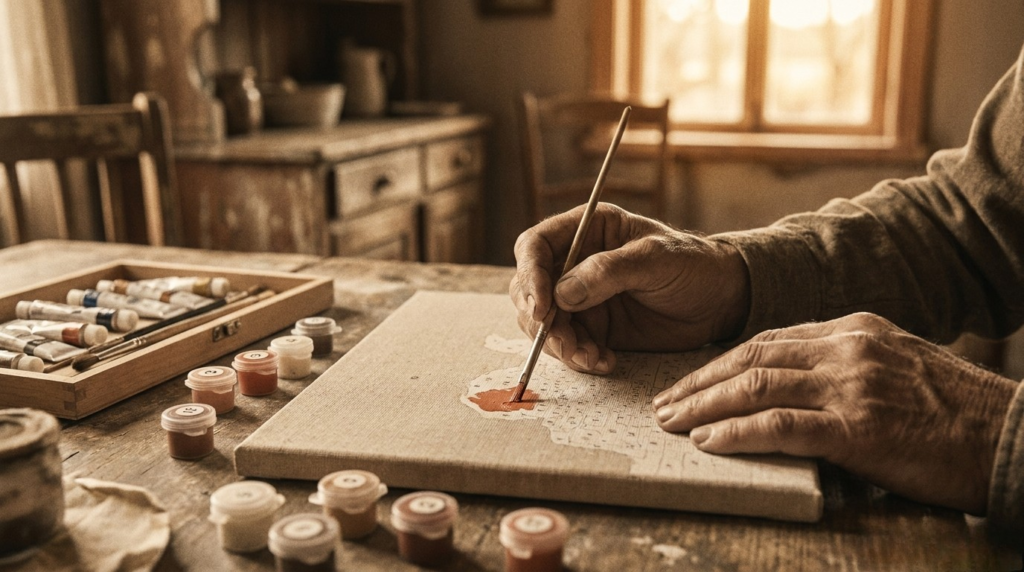
No — and the format was built at a scale that assumes you don’t have any. Craft Master employed hundreds of professional artists to develop the kitschy scenes that were associated with the genre. The business model depended on people with no art training enjoying and completing the canvas. Modern kits don’t stray from that principle.
For anyone who has avoided craft hobbies specifically because of a self-diagnosed lack of talent, this is a great option. Artistic skill is the one qualification this hobby doesn’t check for.
Will a Finished Canvas Actually Look Good on a Wall?
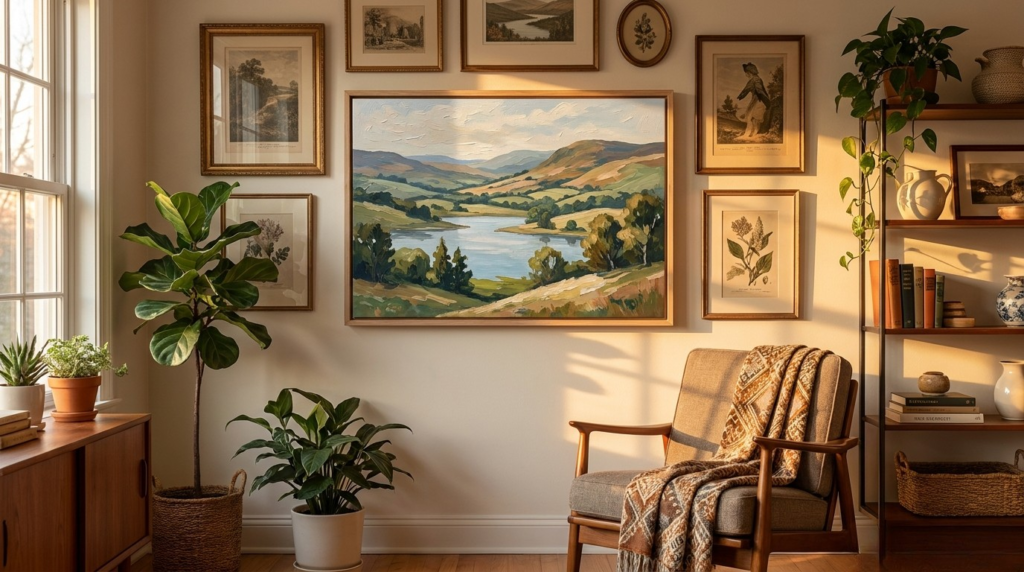
These paintings look better than most people expect, and the current craft market leans towards visible brushwork over another framed print. Pinterest’s 2026 Hobbies Trend Report, points to a broad swing toward textured, handmade wall pieces. A finished paint by numbers canvas fits that same slot: matte acrylic has real texture under gallery lighting, and a simple black or wood frame reads as intentional rather than crafty.
If you’re building a gallery wall or a shelf display that needs a handmade piece in it, a paint by numbers canvas beats another poster.
Does an Out-in-the-Open Station Actually Cut Down on Phone Time?
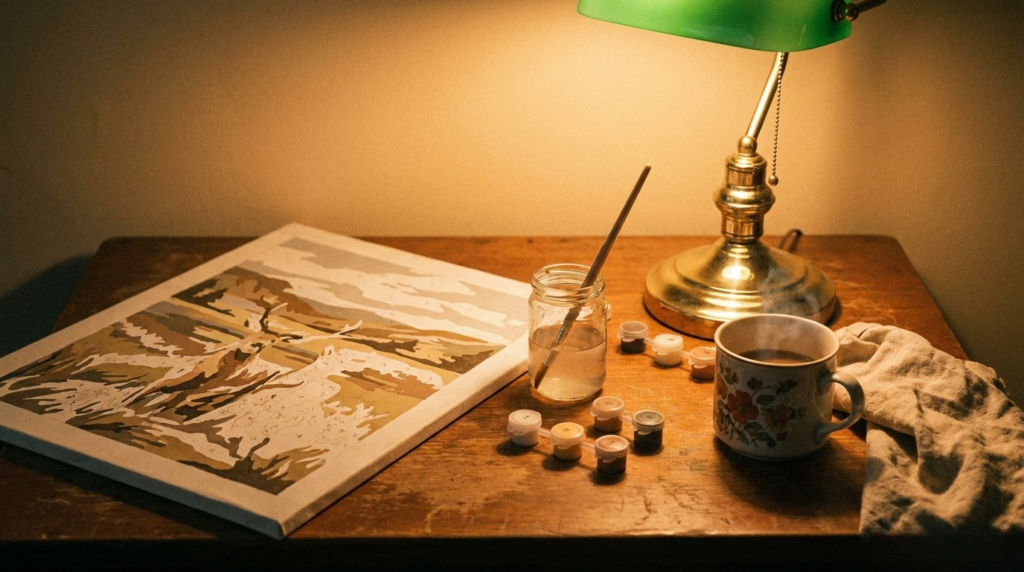
Yes, and it’s less about the painting than about what’s visible. Duke University psychologist Wendy Wood’s research on habit formation found that most repeated behavior is triggered by environmental cues, not intention. According to Wood, it’s as simple as “…physical locations are some of the most powerful cues to behavior.” People reach for a snack, a show, or a phone because they are in view and in reach, not because they consciously decided to pick them up. A phone sits zero effort away in a pocket or side table. A paint-by-numbers canvas boxed in a closet sits several steps and a decision away, so the phone wins by default.
Leave the canvas in a readily available location with the brush already sitting in a water cup, and painting becomes an easier reach than the phone. Move the phone to another room while you are painting.
Paint by number is perfect for anyone who has tried to build a no-phone evening habit and had it fail within a week. The fix is a visible hobby station with an easy, enjoyable activity, not more willpower.
How Not to Get Derailed
Don’t let paint dry out between sessions. Acrylic paint pots left open for a few days go tacky or crack, and a dried-out color mid-canvas is one of the fastest ways a project gets abandoned. The fix is snap-lid pots, or a damp paper towel pressed over open pots between sessions — not a full re-buy.
Select a reasonable size for your first canvas. A large canvas with 60 or more numbered colors is a multi-month project. Pulling it out on a Tuesday guarantees it looks the same on Friday. That reads as failure even when nothing went wrong. A smaller canvas with a reduced color count finishes in a few weeks of short sessions and keeps momentum a bigger piece can’t.
Don’t move the project out of view. If putting it away and setting it back up both take more than a minute, painting stops happening. Leave the water cup filled and the brush resting in it — starting should take zero setup, not five minutes of prep.
Common Questions
Do you need special brushes or paint to start?
No. Most kits include the brushes and pre-mixed acrylic paint needed for that specific canvas. A basic round brush in one or two sizes covers nearly every section; specialty brushes only matter once you’re painting free hand, which isn’t the point of this format.
How long does a typical canvas take to finish?
A smaller canvas with a limited color count usually finishes in 5 to 8 evening sessions of 20 to 40 minutes each. A large, detailed canvas with 60-plus colors can take several months at that same pace — pick the size based on your actual schedule, not your ambition.
Can you frame a paint-by-numbers canvas like real art?
Yes. Once the paint is fully dry, usually after 24 to 48 hours, the canvas can go straight into a standard frame or float frame, no different from any other acrylic painting. Nothing about the numbered process shows once it’s finished and hung.
What happens if you paint outside the lines?
Acrylic paint is opaque and dries fast, so a small mistake gets painted over by the next color without leaving a mark. This is one of the more forgiving adult crafts specifically because errors are correctable, not permanent.
The Bottom Line
Paint by numbers isn’t a workaround for people who can’t paint. It’s a pre-designed format that takes talent out of the mix. The numbers do the composing, the pre-mixed paint does the color matching, and what’s left is a genuinely calming, screen-free hobby. It gives adults a low-effort entry point craft project that replaces the urge to scroll. Set the canvas up somewhere visible, keep the brush already wet, and the biggest resistance to starting disappears.
Not sure which analog swap actually fits your evenings? Take the Quiz to find your best Stop Scrolling swap.
Sources
Thank Dan Robbins for the Paint-by-Number Craze — Smithsonian Magazine
Can Coloring Mandalas Reduce Anxiety? — Art Therapy: Journal of the American Art Therapy Association
Key to Changing Habits Is In Environment, Not Willpower, Duke Expert Says — Duke University
Pinterest Hobbies Trend Report 2026: Find your joy